Distilled water is classified as non-hazardous under OSHA and international safety standards, but Material Safety Data Sheets (MSDS) for distilled water remain essential documentation for workplace compliance, laboratory protocols, and institutional purchasing requirements. These sheets confirm what the distillation process achieves: water stripped of minerals, contaminants, and dissolved solids, leaving a product so pure it requires no warning labels or special handling procedures.
Understanding why such documentation exists for an inherently safe substance reveals much about modern regulatory frameworks and quality assurance. Businesses need these sheets to satisfy insurance requirements, safety audits, and chemical inventory systems that track every substance on site, regardless of hazard level. Laboratory managers use them to verify that their distilled water meets specifications for sensitive equipment and procedures. Even educational institutions rely on these documents to demonstrate due diligence in their science programs.
The environmental story matters here too. Distilled water’s MSDS documentation highlights its chemical simplicity: H2O and nothing else. No disposal restrictions, no environmental reporting thresholds, no protective equipment mandates. This simplicity reflects the efficiency of distillation technology, which produces water clean enough for medical devices, scientific instruments, and applications where purity directly impacts outcomes. For those evaluating water solutions in 2026, the MSDS serves as scientific proof of what distillation delivers without the complexity that comes with chemical treatments or additives.
Understanding the Material Safety Data Sheet for Distilled Water
A Safety Data Sheet (SDS), formerly known as a Material Safety Data Sheet (MSDS), is a standardized document that communicates the physical, health, and environmental hazards of a chemical substance. The Occupational Safety and Health Administration (OSHA) requires these sheets for virtually all chemicals used in workplaces, including those classified as non-hazardous. The Globally Harmonized System of Classification and Labelling of Chemicals (GHS) standardizes the format worldwide, ensuring consistency across borders and industries.
Under OSHA’s Hazard Communication Standard, employers must maintain accessible labels and safety data sheets for all chemicals present in the workplace. This requirement extends to distilled water used in laboratories, manufacturing facilities, educational institutions, and healthcare settings. The documentation isn’t there because distilled water is dangerous; it exists to provide complete transparency about what workers are handling and to establish baseline safety protocols.
The 16-section SDS format creates a comprehensive reference that covers everything from product identification to disposal considerations. For distilled water, most sections confirm the absence of hazards rather than listing precautions. This documentation serves practical purposes: it verifies purity for quality control, establishes proper storage conditions, provides emergency response guidance for spills or exposures, and ensures compliance during inspections. Commercial purchasers often require SDS documentation before accepting shipments, making these sheets essential business documents regardless of the product’s hazard level.
Key Sections of a Distilled Water Safety Data Sheet
Hazard Identification and Classification
Under the Globally Harmonized System of Classification and Labelling of Chemicals (GHS), distilled water receives the most favorable safety classification possible: non-hazardous. The SDS hazard identification section typically shows zeros across all risk categories, meaning no health hazards, no flammability concerns, and no reactivity dangers.
This classification reflects distilled water’s chemical nature as pure H₂O without contaminants, additives, or reactive compounds. Unlike many workplace substances, distilled water requires no hazard pictograms, signal words, or precautionary statements on its labeling. The National Fire Protection Association (NFPA) diamond similarly rates it 0-0-0 for health, flammability, and reactivity.
The hazard statement section of the SDS often reads simply: “Not classified as hazardous” or “No known hazards.” This doesn’t mean the documentation is unnecessary. Rather, it confirms through standardized testing and evaluation that distilled water poses no risks requiring special handling procedures, personal protective equipment, or emergency response protocols.
This classification holds across different exposure routes, ingestion, inhalation of vapor, skin contact, and eye contact all present minimal concern. The purification process that creates distilled water removes the very substances that might otherwise trigger hazard classifications, leaving behind only pure water molecules.
Handling, Storage, and Disposal Information
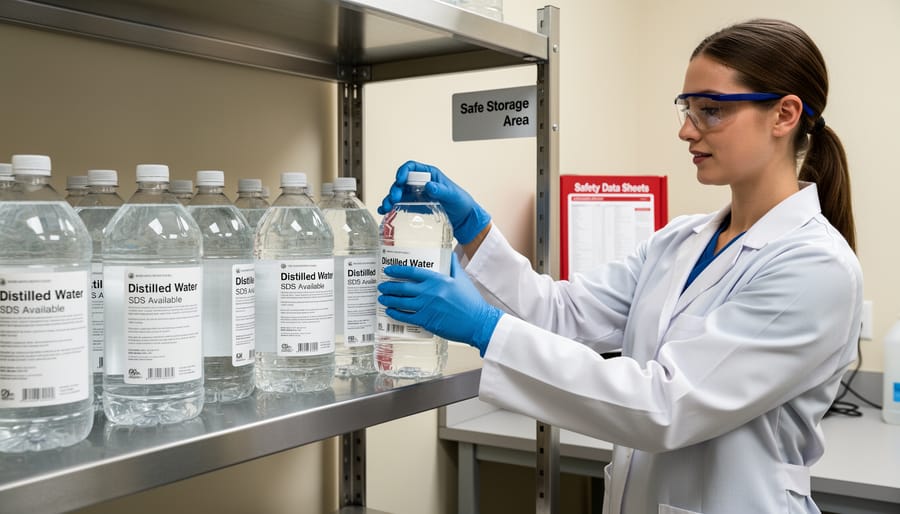
Distilled water SDS documents provide straightforward handling guidance precisely because the substance poses no hazards. Store distilled water in clean, sealed containers away from direct sunlight and potential contaminants, glass or food-grade plastic works best for maintaining purity. Keep containers tightly closed when not in use to prevent airborne particles or microorganisms from entering. Most SDS documents specify storage temperatures between 4°C and 30°C (39°F to 86°F), though distilled water remains stable outside this range.
Contamination prevention matters more than safety risks. Avoid storing distilled water near chemicals, cleaning agents, or industrial materials that could leach into containers or compromise purity through cross-contamination. Use dedicated dispensing equipment rather than dipping cups or tools directly into storage vessels.
Disposal is environmentally simple: distilled water can go directly into standard drains or wastewater systems without special treatment. It contains no pollutants requiring neutralization or hazardous waste protocols. For large commercial quantities, local wastewater regulations still apply, though distilled water typically meets all discharge standards. The SDS confirms what common sense suggests, pure water returns safely to the water cycle.
Safety Profile: Why Distilled Water Is Non-Hazardous
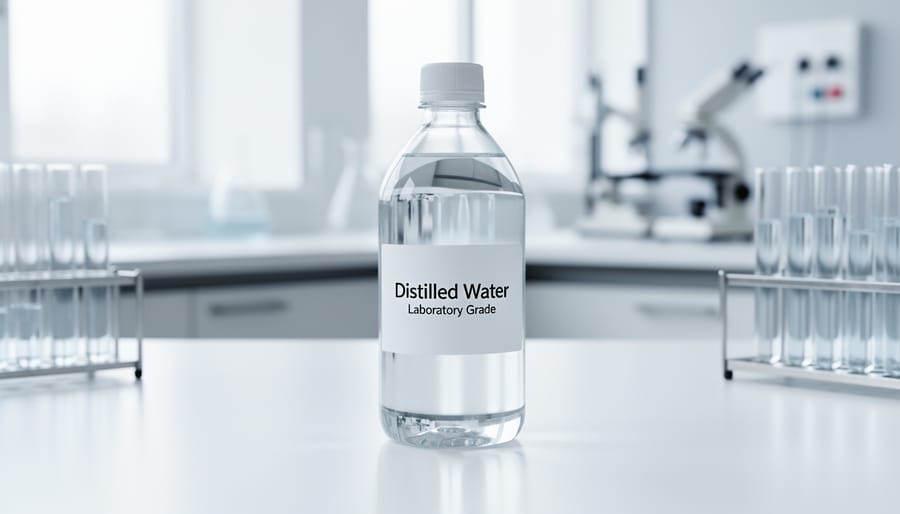
Distilled water earns its non-hazardous classification because the distillation process produces chemically pure H₂O with virtually no dissolved solids, minerals, organic compounds, or reactive substances. When water is heated to boiling and the resulting steam is condensed, contaminants with higher boiling points, including heavy metals, salts, bacteria, viruses, and chemical pollutants, are left behind in the boiling chamber. This physical separation creates water that typically measures less than 1 part per million total dissolved solids, a purity level that eliminates the health and safety concerns associated with tap or untreated water sources.
The absence of contaminants means distilled water presents no toxicity risk through ingestion, skin contact, or inhalation. It contains no carcinogens, mutagens, reproductive toxins, or sensitizing agents. Unlike many chemicals that require protective equipment for handling, distilled water requires only standard hygiene practices. Its neutral pH (close to 7.0 when freshly distilled) and lack of reactive compounds mean it won’t corrode containers, release harmful fumes, or react dangerously with other substances under normal conditions.
Advanced purification methods that combine distillation with additional treatments, such as ozone purification or processes where filtration removes contaminants before distillation, create an even higher purity standard. These multi-barrier approaches ensure that trace organic compounds, volatile chemicals, and any remaining particulates are eliminated, producing water that consistently meets or exceeds safety standards for drinking, laboratory use, and medical applications.
The non-hazardous designation in safety data sheets reflects this reality: distilled water is pure enough to drink safely, gentle enough for sensitive applications like CPAP machines and humidifiers, and stable enough to store without special precautions. Its safety profile makes it suitable for homes, laboratories, and industrial settings without triggering hazardous material handling protocols.
When You Need an MSDS for Distilled Water
Most workplaces and commercial facilities need an MSDS for distilled water not because it’s dangerous, but because safety documentation systems require records for every substance on site. OSHA’s Hazard Communication Standard mandates that employers maintain safety data sheets for all chemicals and substances employees might encounter, regardless of hazard level. This creates a comprehensive safety reference system where workers can look up any product they handle.
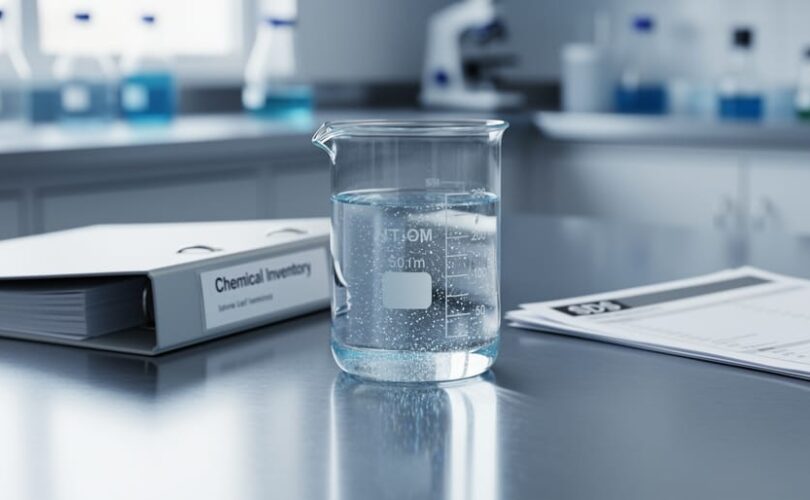
Laboratories face the strictest documentation requirements. Whether you’re running a university research facility, quality control lab, or medical testing center, regulatory bodies expect complete SDS files for every reagent and solvent, including distilled water used for dilutions, equipment cleaning, or as a control standard. Accreditation inspections routinely check these records.
Educational institutions need distilled water MSDS documents in science classrooms and teaching labs. School districts and colleges maintain chemical inventories that include even benign substances to demonstrate proper safety management and liability protection. Teachers reference these sheets when training students on laboratory protocols.
Commercial operations using distilled water for manufacturing, medical procedures, or product formulation must provide SDS documentation to meet industry compliance standards. Healthcare facilities require them for sterilization processes. Food and beverage producers need them for quality assurance programs.
Shipping and transportation represent another critical scenario. Carriers often request safety data sheets for any liquid cargo, confirming is distilled water safe for transport and exempt from hazardous materials handling requirements. The documentation simplifies customs clearance and satisfies freight forwarding protocols, even when the substance poses zero risk.
Environmental and Sustainability Considerations
The safety documentation for distilled water extends beyond workplace compliance, it plays a meaningful role in environmental stewardship. When facilities maintain accurate SDS records, they create accountability systems that prevent water contamination and ensure responsible resource use throughout the supply chain.
Proper handling protocols outlined in distilled water SDS documents help protect natural water systems. By specifying storage conditions that prevent contamination, these guidelines ensure distilled water maintains its purity until use, eliminating waste from spoiled or compromised batches. This matters because manufacturing replacement water consumes energy and resources. When businesses follow SDS storage recommendations, they maximize the usable life of every gallon produced.
The disposal section of an SDS, even for non-hazardous distilled water, encourages environmentally conscious practices. Facilities learn to reclaim distilled water for non-critical uses before disposal, reuse it in cleaning applications, or return it to municipal systems without introducing contaminants. This documentation framework supports safer, planet-friendly water management practices that reduce overall consumption.
By treating distilled water with the same documentation rigor as other substances, organizations build cultures of environmental responsibility. They track quantities, minimize waste, and consider lifecycle impacts, habits that extend to all resources. For companies committed to sustainability, the SDS becomes more than a compliance document. It’s a tool for demonstrating measurable progress toward conservation goals while maintaining the exceptional purity standards that make distilled water valuable in the first place.
Common Questions About Distilled Water Safety Documentation
Getting answers to practical questions about distilled water safety documentation can save time and ensure you meet your obligations, whether you’re managing a workplace, running a laboratory, or simply want to verify what you’re using at home.
Where can I obtain an MSDS for distilled water?
You can request an SDS directly from your distilled water supplier or manufacturer, who must provide it upon request. Many suppliers also make these documents available on their websites as downloadable PDFs.
Do I need an MSDS if I only use distilled water at home?
Home users typically don’t need an MSDS for personal use. This documentation is primarily required for workplaces, laboratories, educational institutions, and commercial facilities where regulatory compliance and worker safety protocols apply.
How does a distilled water SDS differ from one for tap water?
Distilled water’s SDS reflects its high purity and absence of minerals, chemicals, or contaminants found in tap water. Unlike municipal water that contains chlorine, fluoride, and various dissolved minerals, distilled water’s composition section simply lists H₂O with trace impurities measured in parts per million.
Does distilled water expire or lose its safety status?
Properly stored distilled water in sealed containers remains safe indefinitely. The SDS storage section typically notes that exposure to air can allow carbon dioxide absorption (forming weak carbonic acid) or contamination, but this doesn’t create hazards, it simply means the water is no longer purely distilled.
Understanding these fundamentals helps you navigate documentation requirements efficiently. If you’re purchasing distilled water for commercial or institutional use, verify that your supplier can provide current SDS documents that meet OSHA’s Hazard Communication Standard and GHS formatting requirements. Educational facilities should keep copies on file for laboratory inventory compliance, even though distilled water poses no actual hazards.
For businesses with safety management systems, filing the SDS alongside other workplace chemical documentation demonstrates due diligence and supports your environmental health and safety programs. The document serves as proof that you’ve evaluated all substances in your facility, reinforcing a culture of transparency and responsible stewardship that aligns with broader sustainability commitments.
The material safety data sheet for distilled water tells a reassuring story: pure H₂O, stripped of contaminants through rigorous distillation, presents no hazards to human health or the environment. Yet this documentation serves purposes far beyond confirming what distillation already proves. It enables workplace compliance, supports environmental stewardship through proper handling protocols, and provides transparent information that empowers informed decisions about water quality.
Whether you’re managing laboratory operations, maintaining business records, or simply seeking verification of water purity, the MSDS confirms distilled water’s exceptional safety while establishing best practices for storage and disposal. This documentation framework protects both people and ecosystems by preventing contamination and ensuring responsible use.
Understanding your distilled water’s safety profile isn’t just about regulatory boxes to check. It reflects a commitment to science-backed purity, environmental responsibility, and transparency in every drop. When you choose distilled water backed by comprehensive safety documentation, you’re choosing water purification that meets the highest standards for both human health and planetary stewardship. That clarity matters, whether you’re filling laboratory equipment or ensuring the purest water reaches your home.