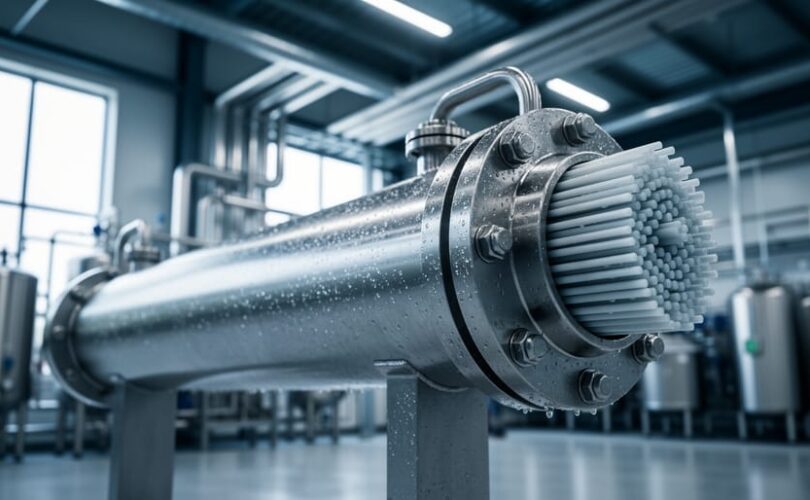
Wastewater treatment membrane technology uses thin, semi-permeable barriers to separate water from the contaminants dissolved or suspended in it. Water passes through microscopic pores while particles, bacteria, and many dissolved substances are held back, leaving a cleaner stream on one side and a concentrated waste stream on the other. No single chemical dose does the work. It’s physical separation, and it’s precise.
That precision is why membranes have become central to modern water reuse. Cities, factories, and farms increasingly treat wastewater to a standard that lets it return to irrigation, industrial processes, or local waterways instead of being discarded. Membranes make that possible while using less space and fewer chemicals than many conventional methods, which is good news for both budgets and ecosystems. They also sit at the heart of advanced filtration the same science that powers many of today’s most effective purification systems.
This guide explains how membranes separate contaminants, how fouling is managed and cleaned, which types exist, and where they’re used today.
What Wastewater Treatment Membrane Technology Means
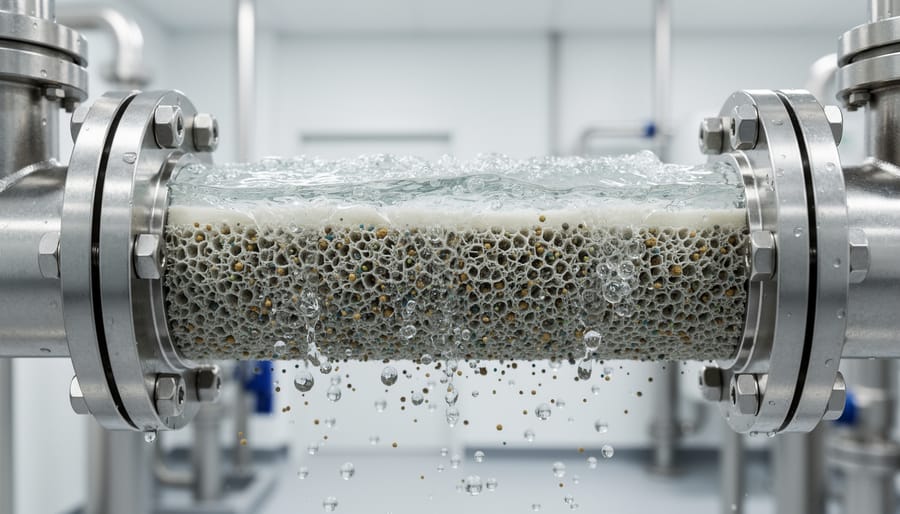
Think of a membrane as a very fine, very picky gatekeeper. It’s a thin barrier engineered to let water slip through while holding back particles, microbes, salts, and dissolved pollutants. Researchers often describe membranes as selective barriers because what they block depends on how the barrier is built, not on a chemical reaction or a long wait.
A few core terms make the rest of this article easier to follow:
- Membrane
- A thin, selective layer that allows some substances, mainly water, to pass while stopping others.
- Permeate
- The cleaned water that passes through the membrane.
- Retentate
- Everything the membrane holds back, including particles, microbes, and concentrated contaminants.
- Pore size
- The tiny openings in the membrane that largely determine what can get through.
- Filtration flux
- The rate at which water moves through a given area of membrane, a key measure of performance.
This is a different idea from traditional treatment. Settling lets heavy solids sink to the bottom of a tank. Chemical treatment adds coagulants or disinfectants to clump or neutralize contaminants. Biological treatment relies on microorganisms to consume dissolved organic matter. Membranes add something these methods can’t do on their own: a physical barrier with a defined cutoff, so the quality of the water that comes out is consistent and predictable.
That doesn’t make older methods obsolete. Among Water Treatment Technologies, membranes often work alongside them, with settling and biological stages doing the heavy lifting upstream and membranes providing a final, precise polish. Many modern plants combine all of these approaches.
This matters because high-quality permeate can be reused for irrigation, industrial processes, or even drinking water supplies. Every gallon reused is a gallon we don’t pull from rivers and aquifers, and a gallon of untreated discharge kept out of the environment.
How Membrane Filtration Works Step by Step
Separation Mechanisms: Size, Charge, and Pressure
A membrane works a lot like a very fine sieve. Picture a kitchen colander: spaghetti stays behind while the water drains through. A membrane does the same thing at a microscopic scale. Its pores are so small that particles, bacteria, and larger molecules simply can’t squeeze through, a process known as size exclusion. The tighter the pores, the smaller the contaminants that get held back.
Size isn’t the whole story, though. Many membrane surfaces carry a slight electrical charge. Because like charges repel, a negatively charged surface can push away negatively charged ions and organic molecules even when they’re small enough to fit through the pores. Think of it as an invisible bouncer working alongside the sieve.
Then there’s pressure, the force that makes it all happen. Left alone, water would barely trickle through such a dense barrier. A pump pushes the water against the membrane, and the harder it pushes, the finer the separation it can achieve. Coarser membranes need only gentle pressure, while tight ones that remove dissolved salts need considerably more.
The result is two streams. The cleaned water that passes through is called permeate, and everything held back becomes the concentrate, or retentate, which is then managed separately.
Fouling, Cleaning, and Keeping Membranes Performing
Every membrane is a working surface, and over time that surface collects what it was built to hold back. This buildup is called fouling. Particles stack up into a cake layer, organic matter and microbes form a slimy biofilm, and dissolved minerals can crystallize into scale. The result is that water moves through more slowly, so the system needs more energy to deliver the same flow.
The good news is that fouling is manageable. Most systems use backwashing, where clean water or air briefly flows in reverse to lift loose material off the membrane. When that isn’t enough, a gentle chemical clean takes over. Mild acids dissolve mineral scale, while cleaners such as chlorine or caustic solutions break down organic films and biofilm. Operators typically schedule these cycles rather than waiting for performance to drop.
Pre-treatment is the quiet hero here. Screening, settling, and coarse filtration remove the heaviest material before it ever reaches the membrane, so there’s far less to clean off later. Well-designed pre-treatment can noticeably extend membrane life.
That matters for sustainability. Longer-lasting membranes mean fewer replacements, less energy per gallon treated, and less chemical use over time. Keeping a membrane healthy is really about keeping the whole system efficient.
Types of Membranes and System Components
Microfiltration, Ultrafiltration, Nanofiltration, and Reverse Osmosis
Think of the four main membrane classes as a series of finer and finer sieves. Each one is defined by the size of its pores, and that size decides what it stops and what it lets through.
Microfiltration (MF) is the coarsest. Its pores are roughly 0.1 to 10 micrometers wide, which is enough to hold back suspended solids, sediment, algae, and most bacteria. Wastewater plants often use it as a first polishing step or to protect finer membranes downstream. It runs at low pressure and passes water, dissolved salts, and viruses.
Ultrafiltration (UF) tightens the mesh to about 0.01 to 0.1 micrometers. It captures everything MF does, plus viruses, many proteins, and colloids, the tiny suspended particles that make water look cloudy. UF is a workhorse for producing clear, microbiologically safer water at modest pressure.
Nanofiltration (NF) moves into dissolved territory. Its pores are around one nanometer, and its surface carries a charge, so it removes many organic compounds and multivalent ions such as calcium and magnesium (the minerals behind hard water). It lets some single-charge salts pass, which makes it a selective option when you want to soften or partially purify water.
Reverse osmosis (RO) is the finest. Using higher pressure, it rejects the vast majority of dissolved salts, along with many trace contaminants and small organic molecules. It’s the go-to choice when water needs to be reused at the highest quality.
Choosing among them comes down to the job: coarser membranes need less energy, while finer ones deliver deeper purification.
Membrane Bioreactors and Module Configurations
A membrane bioreactor (MBR) pairs two proven ideas in one compact system. Microorganisms first break down dissolved and suspended organic matter in an aeration tank. A membrane then replaces the settling tank, holding back solids and microbes so the effluent leaves clearer and the biology stays concentrated inside. Because the membrane does the separating, MBRs can fit into a smaller footprint than conventional plants and produce water that is well suited to reuse. Some facilities add ozone treatment as a polishing step when they want extra oxidation after filtration.
Membranes are packaged into modules in a few common formats. Hollow fiber bundles thousands of thin tubes into a compact unit, which is why they’re popular in MBRs. Spiral wound modules roll flat sheets around a central tube and are the usual choice for nanofiltration and reverse osmosis. Flat sheet membranes sit in stacked plates or panels, and they tend to be easy to inspect and clean.
A typical membrane treatment system brings together several parts that work as a team:
- Pre-screening and pre-treatment remove debris and coarse solids that could damage or clog the membranes.
- The bioreactor tank hosts the microorganisms that digest organic pollutants.
- Membrane modules act as the selective barrier that separates clean permeate from solids.
- Pumps or a vacuum supply the driving force that moves water through the membrane.
- Aeration and scouring systems supply oxygen and help keep membrane surfaces clear.
- Cleaning systems handle backwashing and periodic chemical cleaning to restore flow.
Together, these pieces turn a simple barrier principle into a reliable, repeatable treatment process.
How Membrane Technology Is Used Across Homes, Industry, and Cities
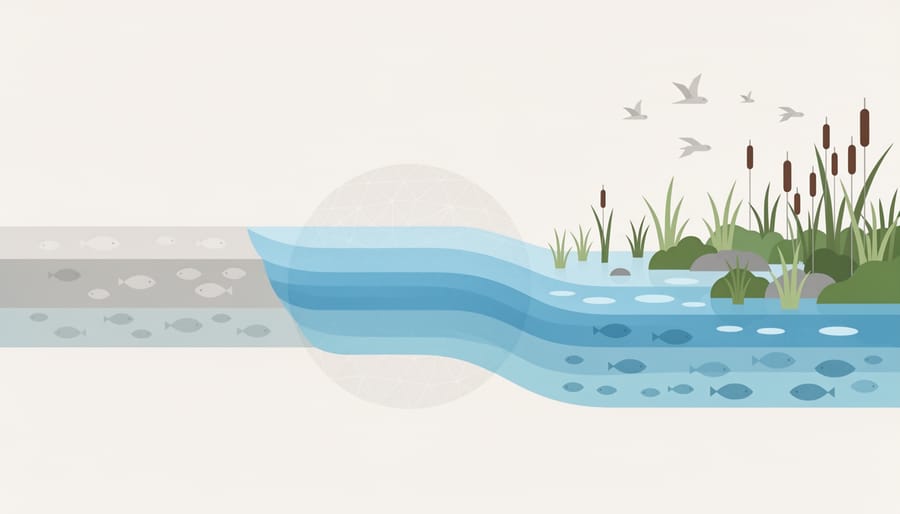
Membrane technology works well beyond the treatment plant. The same barrier principle that cleans a city’s wastewater shows up in factories, farms, and kitchens, and in each setting the goal is the same: use water more than once and send less pollution back into the environment.
Here are the most common applications, each with its main environmental payoff:
- Municipal wastewater reclamation: Treated city water can be reused for irrigation, cooling, or groundwater recharge, easing pressure on freshwater supplies.
- Industrial process water recovery: Factories capture and reuse process water, cutting both intake and discharge.
- Agriculture and irrigation reuse: Filtered water keeps crops growing while reducing demand on rivers and aquifers.
- Resource recovery: Membranes can concentrate valuable materials from a waste stream so they can be reclaimed instead of lost.
- Drinking water purification: Fine membranes reduce dissolved contaminants, supporting safe tap water from a wider range of sources.
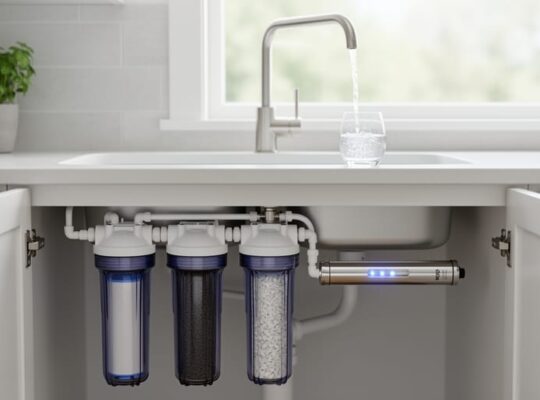
Take away the scale, and the picture at home looks familiar. A household or commercial point-of-use system relies on the same ideas described earlier: pore size, surface charge, and pressure working together to hold back unwanted substances while clean water passes through. The membrane in a countertop or under-sink unit is a smaller relative of the ones used in large reclamation plants, and the decades of research behind municipal and industrial systems have helped refine the purification products Living Water customers use every day.
That connection is part of what makes this technology so encouraging. Each reuse loop, whether it happens in a city, a factory, or a family kitchen, means less water drawn from natural sources and less wastewater released downstream. Choosing smart filtration at any scale is one practical way modern treatment methods keep the planet healthy while giving people confidence in the water they drink.
Common Questions About Membrane Wastewater Treatment
Readers tend to ask the same practical questions once they understand the basics, so here are straight answers to the most common ones.
Can membrane-treated wastewater be reused?
Yes. Membrane systems remove particles and microbes very effectively, and finer membranes also reduce dissolved salts. Treated water is commonly reused for irrigation, industrial processes, and, with the right level of treatment, even drinking water supplies.
How long do membranes last?
It depends on the membrane type, the quality of the incoming water, and how well the system is cleaned. With good pre-treatment and regular cleaning, many membranes serve for several years before replacement.
How do membranes compare with conventional treatment?
Conventional methods like settling and biological treatment remain valuable. Membranes add a physical barrier that delivers more consistent water quality in a smaller footprint, and the two approaches often work together.
What happens to the concentrated waste stream?
The retentate carries the contaminants the membrane held back. It is typically treated further, recycled within the process, or disposed of according to local regulations, and some facilities recover useful materials from it.
Membrane technology isn’t a magic fix, but it is a well-understood, science-backed tool. Matching the right membrane to the right job, and maintaining it well, is what delivers cleaner water and meaningful water reuse in practice.
At its heart, membrane technology is a simple idea carried out with remarkable precision: a thin, selective barrier that lets clean water through and holds contaminants back. From microfiltration to reverse osmosis, from membrane bioreactors to the filters under a kitchen sink, the same principle scales to meet each need, turning wastewater into a resource rather than a burden.
That shift matters. Every gallon that is cleaned and reused is a gallon that doesn’t have to be drawn from a stressed river or aquifer, and every pollutant captured is one that never reaches a waterway. As membranes become more durable, efficient, and affordable, the outlook for Water Treatment Technologies keeps getting brighter.
At Living Water, we believe cleaner water should rest on solid science and respect for the planet. Understanding how these systems work is a good first step toward choosing water solutions that serve both your household and the environment.